
Excellent — Day 3 is where you understand why Spark survives failures and why RDDs still matter, even if you mostly use DataFrames.
🧠 DAY 3 — RDDs, Lineage & Fault Tolerance
(Why Spark Works Reliably on AWS)
Goal today:
Understand how Spark recovers from failures without copying data everywhere.
🎯 What You’ll Master Today
By the end of Day 3, you will:
- Understand what an RDD really is
- Know why lineage > replication
- Clearly differentiate narrow vs wide dependencies
- Predict where shuffles and failures happen
- Explain Spark fault tolerance in interviews (confidently)
1️⃣ What Is an RDD (Correct Definition)
❌ Wrong
“RDD is just an old Spark API”
✅ Correct
RDD = Immutable, partitioned dataset with lineage
Key properties:
- Immutable (never changes)
- Partitioned (split across executors)
- Distributed
- Lineage-aware (knows how it was built)
📌 Every DataFrame is built on RDDs internally
2️⃣ Why RDDs Still Matter (Even If You Use DataFrames)
DataFrames give:
- Optimization (Catalyst)
- Ease of use
RDDs give:
- Fault tolerance model
- Execution guarantees
- Understanding of shuffles & recomputation
📌 When things go wrong in production → RDD concepts explain why
3️⃣ RDD Lineage (MOST IMPORTANT CONCEPT TODAY)
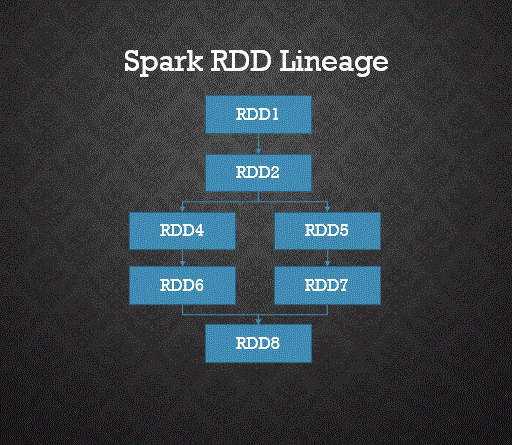

What is Lineage?
Lineage is:
A recipe of transformations used to build a dataset
Example:
rdd1 = sc.textFile("s3://raw/data")
rdd2 = rdd1.filter(...)
rdd3 = rdd2.map(...)
Spark remembers:
rdd3 ← rdd2 ← rdd1
4️⃣ How Spark Recovers from Failure (MAGIC EXPLAINED)
Scenario
- Executor crashes
- Some partitions are lost
Spark does NOT:
❌ Restore from backup
❌ Copy data from another node
Spark DOES:
✔ Look at lineage
✔ Recompute lost partitions
✔ Continue execution
📌 This is why Spark scales well on cloud (cheap + resilient)
5️⃣ Lineage vs Replication (Spark vs Hadoop)
| Hadoop (HDFS) | Spark |
|---|---|
| Replication (3x) | Lineage |
| Storage-heavy | Compute-heavy |
| Disk-based | Memory + compute |
🧠 Spark trades storage for computation
On AWS:
- Storage (S3) is cheap
- Compute is elastic
👉 Perfect match
6️⃣ Narrow vs Wide Dependencies (SHUFFLE EXPLAINED)


Narrow Dependency
- Each child partition depends on one parent
- No data movement
Examples:
mapfilterselect
✔ Fast
✔ Same executor
Wide Dependency
- Child partition depends on many parents
- Requires shuffle
Examples:
groupByjoindistinct
❌ Expensive
❌ Network + disk involved
📌 Wide dependency = stage boundary
7️⃣ Stages Are Built from Dependencies
Spark builds stages like this:
Narrow ops → SAME stage
Wide op    → NEW stage
Example
df.filter(...).select(...).groupBy(...)
filter + select→ Stage 1groupBy→ Shuffle → Stage 2
📌 This explains why Spark UI shows multiple stages.
8️⃣ Why Shuffles Are Dangerous on AWS
On AWS:
- Shuffle = network + disk + S3 I/O
- Large shuffle = slow + expensive
Common Causes
❌ Skewed keys
❌ Too many partitions
❌ Unnecessary wide operations
📌 Most EMR cost overruns = shuffles
9️⃣ Real Production Insight (VERY IMPORTANT)
Why Spark jobs “randomly fail”
- One executor dies
- Spark retries tasks
- Retry hits same skew
- Job fails after retries
📌 Not random — deterministic based on data & lineage
🔥 Interview-Level Questions (You Can Answer Now)
✔ What is RDD lineage?
✔ How does Spark recover from executor failure?
✔ Difference between narrow and wide dependency?
✔ Why does groupBy cause shuffle?
✔ Why Spark doesn’t replicate data like HDFS?
🧪 DAY 3 THINKING EXERCISE (IMPORTANT)
Think about this:
You have a Spark job with 10 stages.
What does that tell you about:
- Number of shuffles?
- Performance risk?
- Optimization opportunities?
(We’ll use this thinking when tuning jobs later.)
🧠 DAY 3 MEMORY ANCHORS (SAVE THIS)
RDD = Immutable + Partitioned + Lineage

Lineage > Replication

Narrow = fast
Wide   = shuffle

Shuffle = cost + risk
🎤 Resume-Grade Line (You Earned This)
Strong understanding of Apache Spark fault tolerance using RDD lineage, narrow and wide dependencies, and shuffle behavior in distributed AWS environments
⏭️ DAY 4 — DataFrames, Spark SQL & Catalyst Optimizer
Tomorrow you’ll master:
- Logical vs physical plans
- Catalyst optimizer
- Why DataFrames are faster than RDDs
- How Spark SQL rewrites your code
This is performance intelligence, not syntax.
Reply with:
DAY 4
and we continue 🚀