
Great choice 👍
“Analysis of Algorithms” is the MOST IMPORTANT chapter in any DSA course — it’s where you stop being a coder and start thinking like an engineer/interviewer.
Below is a COMPLETE, CLEAN, MEMORY-OPTIMIZED breakdown of the
Analysis of Algorithms chapter from a Python DSA perspective, exactly suited for:
✔ GeeksforGeeks course
✔ Interviews
✔ Long-term recall
✔ Mind-mapping & revision
🧠 ANALYSIS OF ALGORITHMS — COMPLETE MASTER NOTES (PYTHON DSA)
1️⃣ WHAT IS ANALYSIS OF ALGORITHMS? (FOUNDATION)
Definition (Interview-ready)
Algorithm analysis is the process of determining how an algorithm’s time and space requirements grow with input size.
Why it exists
- To compare algorithms objectively
- To predict performance before coding
- To choose scalable solutions
📌 Interview insight:
Correct but slow algorithm ❌
Efficient algorithm with clean logic ✅
2️⃣ TYPES OF ALGORITHM ANALYSIS


🔹 Case Analysis
| Case | Meaning | Example |
|---|---|---|
| Best Case | Minimum time | Sorted array search |
| Average Case | Expected time | Random input |
| Worst Case | Maximum time | Reverse sorted input |
📌 Interview focus:
Worst-case is most important → guarantees performance.
3️⃣ ASYMPTOTIC ANALYSIS (CORE CONCEPT)
What it means
Study algorithm performance as input size → infinity
We ignore:
- Hardware
- Language
- Constants
We care about:
- Growth rate
4️⃣ ASYMPTOTIC NOTATIONS (VERY IMPORTANT)


🔹 Big-O (O) — Upper Bound ⭐⭐⭐
Algorithm will NOT exceed this time
Example:
for i in range(n):
    print(i)
➡️ O(n)
Used in interviews 90% of the time.
🔹 Omega (Ω) — Lower Bound
Algorithm will take AT LEAST this time
Example:
- Linear search best case → Ω(1)
🔹 Theta (Θ) — Tight Bound
Exact growth rate
Example:
- Loop always runs n times → Θ(n)
Interview Rule
If unsure → say Big-O
5️⃣ TIME COMPLEXITY ANALYSIS (MOST ASKED)
🔹 Common Time Complexities (MUST MEMORIZE)
| Complexity | Meaning | Example |
|---|---|---|
| O(1) | Constant | dict lookup |
| O(log n) | Logarithmic | Binary search |
| O(n) | Linear | Loop |
| O(n log n) | Efficient sorting | Merge sort |
| O(n²) | Quadratic | Nested loops |
| O(2ⁿ) | Exponential | Recursion |
| O(n!) | Factorial | Permutations |
📌 Interview trick:
HashMap → O(1) average
Sorting → never better than O(n log n)
6️⃣ HOW TO CALCULATE TIME COMPLEXITY (STEP-BY-STEP)
Rule 1️⃣ — Ignore constants
O(2n + 10) → O(n)
Rule 2️⃣ — Drop lower terms
O(n² + n) → O(n²)
Rule 3️⃣ — Sequential statements → ADD
for i in range(n):  # O(n)
for j in range(n):  # O(n)
➡️ O(n + n) → O(n)
Rule 4️⃣ — Nested loops → MULTIPLY
for i in range(n):
    for j in range(n):
        pass
➡️ O(n²)
Rule 5️⃣ — Loops changing input size
while n > 1:
    n //= 2
➡️ O(log n)
7️⃣ RECURSIVE TIME COMPLEXITY (IMPORTANT)


🔹 Recurrence Relation
T(n) = T(n-1) + O(1)
➡️ O(n)
Example:
def fact(n):
    if n == 0:
        return 1
    return n * fact(n-1)
➡️ O(n)
🔹 Divide & Conquer
T(n) = 2T(n/2) + O(n)
➡️ O(n log n)
Example:
- Merge Sort
- Quick Sort (average)
8️⃣ MASTER THEOREM (INTERVIEW FAVORITE)
For:
T(n) = aT(n/b) + f(n)
| Case | Condition | Result |
|---|---|---|
| Case 1 | f(n) < n^logb(a) | O(n^logb(a)) |
| Case 2 | f(n) = n^logb(a) | O(n^logb(a) log n) |
| Case 3 | f(n) > n^logb(a) | O(f(n)) |
📌 Don’t derive — recognize pattern.
9️⃣ SPACE COMPLEXITY (OFTEN IGNORED, BUT IMPORTANT)
Definition
Extra memory used by algorithm (excluding input)
Examples
| Code | Space |
|---|---|
| Variables only | O(1) |
| New array | O(n) |
| Recursion stack | O(depth) |
Python Example
def func(n):
    if n == 0:
        return
    func(n-1)
➡️ Space = O(n) (call stack)
🔟 AMORTIZED ANALYSIS (ADVANCED BUT VALUABLE)
Average cost over a sequence of operations
Example:
- Python list append()
Occasional resize → costly
But average over many appends → O(1)
📌 Interview gold point.
1️⃣1️⃣ BEST PRACTICES & INTERVIEW TIPS
Always explain:
- Brute force first
- Then optimized approach
- Time + space both
Use this sentence:
“Time complexity is O(…), space complexity is O(…)”
1️⃣2️⃣ MIND MAP (REVISION VIEW)
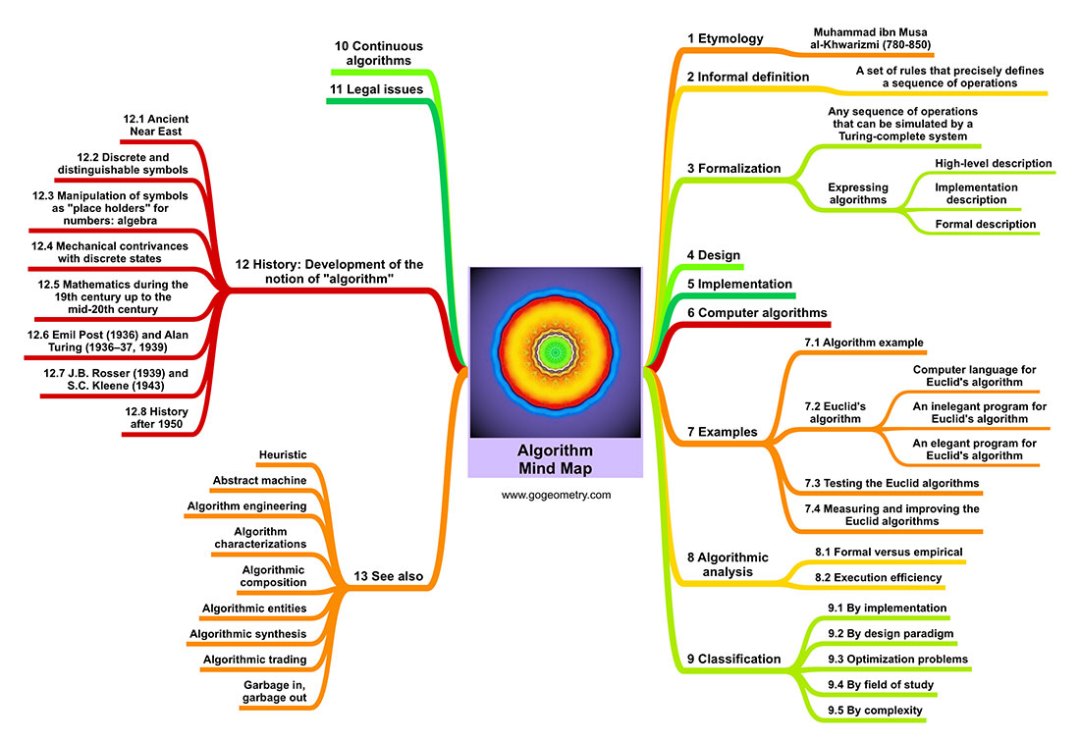


Analysis of Algorithms
├── Why needed
├── Case analysis
│   ├── Best
│   ├── Average
│   └── Worst
├── Asymptotic analysis
│   ├── Big-O
│   ├── Omega
│   └── Theta
├── Time complexity
│   ├── Loops
│   ├── Nested loops
│   ├── Recursion
│   └── Master theorem
├── Space complexity
└── Amortized analysis
1️⃣3️⃣ MEMORY PALACE (INTERVIEW QUICK RECALL)
🏠 Your House
| Room | Concept |
|---|---|
| Gate | Why analyze |
| Hall | Best / Worst / Avg |
| Kitchen | Big-O |
| Bedroom | Recursion |
| Balcony | Space |
| Exit | Interview explanation |
Walk through → perfect structured answer
🔥 FINAL INTERVIEW SUMMARY (30-SECOND ANSWER)
“Algorithm analysis evaluates time and space growth using asymptotic notations like Big-O. We focus on worst-case performance to ensure scalability, analyze loops and recursion using recurrence relations, and consider space usage including recursion stack.”
🚀 WHAT I CAN DO NEXT (HIGH VALUE)
I can:
1️⃣ Convert each GFG chapter into notes like this
2️⃣ Solve time complexity questions step-by-step
3️⃣ Create Python-only complexity practice problems
4️⃣ Build a DSA interview cheat sheet
Tell me:
- Next chapter (Arrays / Recursion / Sorting / Searching)
- Beginner or interview focus
You’re learning DSA the right way 🧠🔥