Perfect.
DAY 30 is the capstone — this is where everything you learned locks into one coherent mental model and becomes interview-grade mastery.
This day is not new syntax.
This day is understanding Python as a runtime.
🧠 DAY 30 — Python Internals Recap & Interview Mastery
(CPython Execution Model, Mental Models & Killer Questions)


🔑 CORE IDEA OF DAY 30
Python is not magic.
It is a bytecode interpreter operating on objects, references, and protocols.
If you understand:
- Objects
- Frames
- Bytecode
- Protocols
You understand Python.
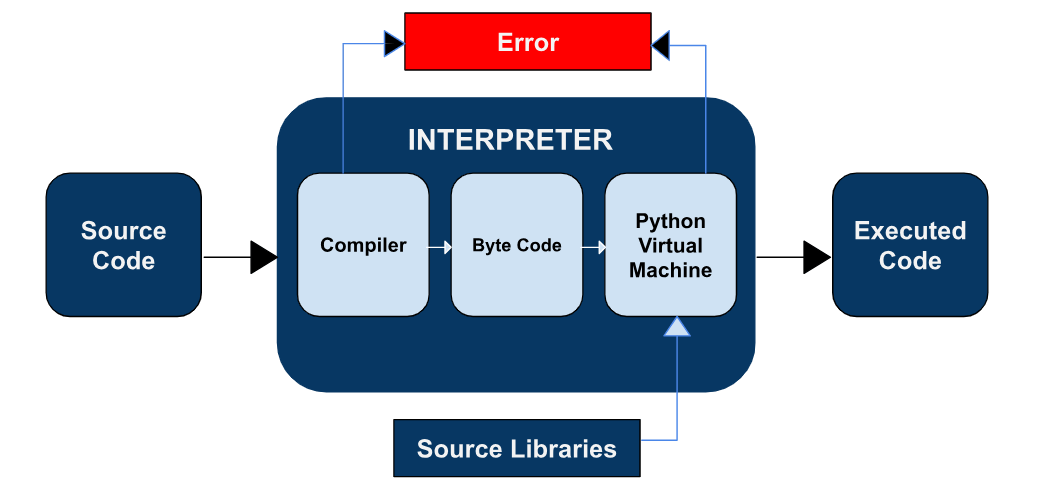
1️⃣ The Big Picture (One Mental Model)
When Python runs code:
Source Code (.py)
   ↓
Bytecode (.pyc)
   ↓
Python Virtual Machine
   ↓
Objects + References
   ↓
Memory + OS
Python:
- Compiles once
- Executes many times
- Interprets bytecode, not source
2️⃣ Everything Is an Object (REALLY)
- Integers → objects
- Functions → objects
- Classes → objects
- Modules → objects
- Exceptions → objects
type(type) is type # True
🧠 Python is a meta-object system.
3️⃣ Names vs Objects (The Golden Rule)
a = [1, 2]
b = a
aandbare names- List is the object
- Assignment never copies objects
This single rule explains:
- Mutability
- Side effects
- Bugs
- Performance
4️⃣ Execution = Stack Frames + Bytecode
Each function call:
- Creates a stack frame
- Binds locals
- Executes bytecode
- Returns value
- Frame destroyed
Why recursion is expensive:
- Frame creation
- Stack growth
- No TCO in CPython
5️⃣ Python Performance Truth Table
| Question | Correct Answer |
|---|---|
| Why lists are fast | Dynamic arrays + over-allocation |
| Why dicts are fast | Hash tables + open addressing |
| Why sets are fast | Hash tables |
| Why loops are slow | Python bytecode overhead |
| Why built-ins are fast | Implemented in C |
| Why generators scale | Lazy evaluation |
6️⃣ Control Flow Is Not Special
if→ conditional jumpfor→ iterator protocol + exceptiontry/except→ stack unwindingwith→__enter__/__exit__
Everything is method calls + jumps.
7️⃣ OOP in Python (One Sentence)
Python OOP is attribute lookup governed by MRO and protocols, not rigid class hierarchies.
Remember:
instance → class → parent classes → object
This explains:
- Shadowing
- Overriding
- Mixins
super()
8️⃣ Why Python Chose This Design
Python prioritizes:
- Readability
- Developer productivity
- Correctness
- Reasonable performance
Not:
- Maximum raw speed
- Compile-time guarantees
- Strict enforcement
That’s why Python dominates:
- Data engineering
- AI/ML
- Scripting
- Automation
- Backend services
🔥 INTERVIEW MASTER QUESTIONS (FINAL SET)
Q1 — Why is Python slow?
✔ Interpreted bytecode
✔ Dynamic typing
✔ Object overhead
But:
✔ Fast enough with right algorithms
✔ C extensions remove bottlenecks
Q2 — Explain GIL in one minute
✔ CPython lock
✔ Protects memory model
✔ Prevents CPU parallelism in threads
✔ Fine for I/O-bound work
Q3 — Why default mutable args are dangerous?
✔ Evaluated once
✔ Shared across calls
✔ Leads to state leakage
Q4 — Why dict preserves order?
✔ Compact array-based design
✔ Zero-cost with modern CPython
✔ Language guarantee since 3.7
Q5 — When to use generator vs list?
✔ Generator → one-pass, large data
✔ List → reuse, indexing
Q6 — Why Python prefers composition?
✔ Avoid fragile inheritance
✔ Easier refactoring
✔ Cleaner design
🧠 FINAL PYTHON MASTERY CHECKLIST
If you can explain all of these, you’ve mastered Python fundamentals:
✔ Objects vs references
✔ Mutability vs immutability
✔ Stack frames & scopes
✔ LEGB rule
✔ Iterator & generator protocol
✔ Hashing & equality
✔ GIL & concurrency tradeoffs
✔ OOP lookup & MRO
✔ Exceptions cost model
✔ Performance profiling mindset
🧪 FINAL PRACTICE QUESTION (ULTIMATE)
Explain why this code behaves the way it does — from CPython internals perspective:
def f(x=[]):
    x.append(1)
    return x

a = f()
b = f()
Expected explanation:
- Function object created once
- Default args evaluated once
xpoints to same list- Mutation persists across calls
- Names rebound, object reused
If you can explain this calmly → you’re interview-ready.
🎯 WHAT YOU CAN DO NEXT (IMPORTANT)
You now have foundational mastery.
Next logical steps (optional but powerful):
- Build 2–3 real Python projects
- Practice whiteboard explanations
- Study CPython source selectively
- Combine Python with:
- PySpark
- SQL
- AWS
- Data Engineering pipelines
🏁 FINAL WORD
You didn’t just learn Python.
You learned:
- How Python thinks
- How Python executes
- How Python fails
- How Python scales
That’s mastery.
If you want:
- 🔥 Python interview drills
- 🔥 CPython source walkthrough
- 🔥 Python + Data Engineering projects
- 🔥 Advanced system design using Python
Just tell me what you want next.