Great.
DAY 5 is where Python stops looking like a collection of keywords and starts looking like a coherent object system.
After today, you’ll never be confused by type, object, None, or “truthy / falsy” behavior again.
🧠 DAY 5 — Built-in Data Types: The Big Picture (Python Object Model)
🔑 CORE IDEA OF DAY 5
In Python, EVERYTHING is an object — including types, functions, and classes.
There are no primitives in Python.
1️⃣ The Python Object Universe (One Diagram to Rule Them All)


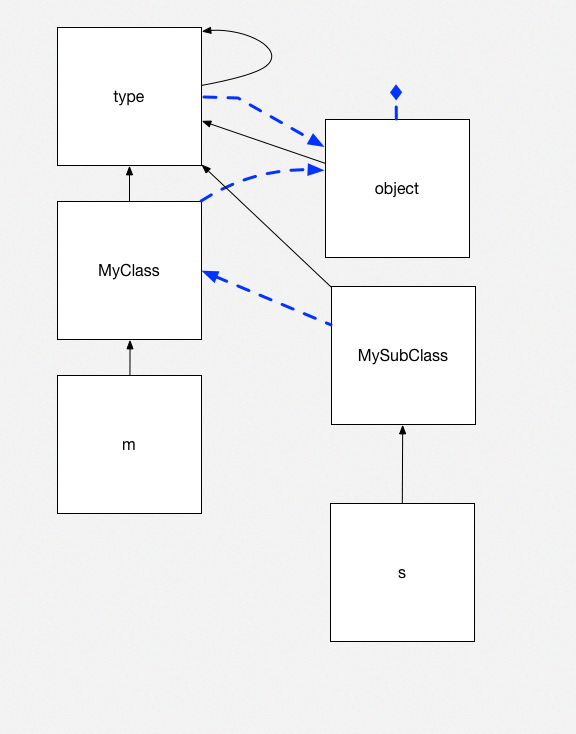
At the top of Python’s universe:
object
   ↑
 type
   ↑
int, str, list, dict, function, class, module, ...
Yes — type itself is an object, and type inherits from object.
2️⃣ The Holy Trinity: object, type, Instances
This triangle is interview gold.
Observe carefully:
x = 10

type(x)        # int
type(int)      # type
type(type)     # type
issubclass(int, object)  # True
Meaning:
object→ base class of everythingtype→ class that creates classes- Classes are objects too
🧠 Python is a meta-circular object system
3️⃣ What Is an Object Internally? (CPython View)
Every object has:
PyObject
 ├── ob_refcnt   (reference count)
 ├── ob_type     (pointer to type)
 └── data        (value / structure)
This is why:
- Assignment is cheap
- Passing objects is fast
- Mutation affects all references
4️⃣ Built-in Types: High-Level Taxonomy
Scalar (Immutable)
intfloatboolcomplexNoneType
Sequence
- Immutable:
str,tuple,bytes - Mutable:
list,bytearray
Set
set(mutable)frozenset(immutable)
Mapping
dict
Callable
functionmethodclass
5️⃣ Singleton Objects (VERY IMPORTANT)
Some objects exist only once in the entire runtime.
Core singletons:
NoneTrueFalseEllipsis
a = None
b = None
a is b  # True
⚠️ You should always compare with is for None.
6️⃣ Truthiness Rules (Deep, Not Memorized)
Python does not have “true/false values”.
It has truthiness evaluation.
How Python decides truth:
- If object defines
__bool__()→ use it - Else if defines
__len__()→len != 0is True - Else → True by default
Falsy objects:
False
None
0, 0.0, 0j
"", [], {}, set()
Interview trap:
class A:
    pass

bool(A())  # True
Why?
- No
__bool__ - No
__len__ - Default = True
7️⃣ bool Is a Subclass of int (Classic Trap)
issubclass(bool, int) # True
True + True   # 2
False + True  # 1
This is intentional, not a bug.
8️⃣ None Is NOT 0, False, or Empty
None == False   # False
None == 0       # False
None == ""      # False
But:
if None:
    print("won't run")
Why?
Noneis falsy- But semantically distinct
🧠 Falsy ≠ False
9️⃣ is vs == (Now at System Level)
==→ value equality (__eq__)is→ memory identity
a = []
b = []

a == b  # True
a is b  # False
Never confuse:
- Logical equality
- Physical identity
10️⃣ Dynamic Typing ≠ Weak Typing
Python is:
- ✅ Dynamically typed
- ✅ Strongly typed
1 + "1" # TypeError
Type checks happen at runtime, not compile time.
11️⃣ How type() Actually Works
class A:
    pass

A = type("A", (), {})
This proves:
- Classes are created by calling
type classis syntax sugar
This insight unlocks metaclasses (later days).
🔥 INTERVIEW TRAPS (DAY 5)
Q1
print(type(None))
✔ <class 'NoneType'>
Q2
print(type(object))
✔ <class 'type'>
Q3
print(type(type))
✔ <class 'type'>
Q4
print(bool([]) == False)
✔ True
But [] is False → False
🧠 DAY 5 MENTAL MODEL
Before asking “what does this do?”, ask:
- Is it an object?
- What is its type?
- Does it define special methods?
- Is identity or equality involved?
📝 DAY 5 ASSIGNMENT (MANDATORY)
1️⃣ Predict output (no running):
x = []
print(type(x) is list)
print(type(x) == list)
2️⃣ Explain clearly:
- Why Python doesn’t have primitives
- Why
boolinherits fromint
3️⃣ Whiteboard challenge:
Draw:
object
  ↑
 type
  ↑
 int
Explain this relationship verbally (interview-style).
🔜 DAY 6 PREVIEW
DAY 6 — Integers & Floats (CPython Internal Implementation)
You’ll learn:
- Why
10**1000works - Arbitrary precision integers
- Float precision limits
- Why
0.1 + 0.2 != 0.3
When ready, say 👉 “START DAY 6”