
Excellent — now we move from API familiarity to problem-solving dominance.
STRING MASTERY – DAY 2 is 100% coding-interview driven.
No fluff. No repetition. Just patterns + traps + solutions.
🔥 STRING MASTERY — DAY 2
Sliding Window, Hashing Patterns & Tricky Interview Problems


🧠 DAY 2 GOAL
By the end of today, you will:
- Instantly recognize string problem patterns
- Solve 90% of string interview questions
- Avoid hidden O(n²) traps
- Explain solutions confidently (interview expectation)
🧩 CORE STRING PATTERNS (MEMORIZE THESE)
Every string interview problem reduces to one of these:
| Pattern | Used For |
|---|---|
| Frequency Map | Anagram, counts |
| Sliding Window | Substrings, windows |
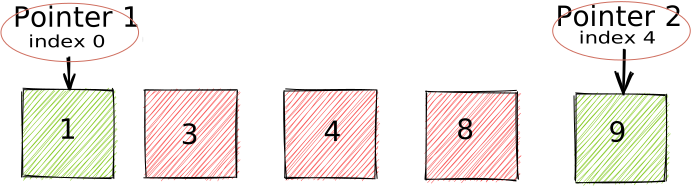
| Two Pointers | Palindrome, reverse |
| Hash Set | Uniqueness |
| Stack | Parentheses |
| Greedy | Compression, removal |
If you identify the pattern → solution is obvious.
1️⃣ SLIDING WINDOW — THE MOST IMPORTANT PATTERN
Used when:
- Substring
- Continuous window
- Longest / shortest
- Condition-based window
🔥 Q1. Longest Substring Without Repeating Characters
(Asked everywhere: FAANG, startups, services)
Problem
"abcabcbb" → 3 ("abc")
❌ Brute Force (DO NOT DO)
- All substrings
- O(n²)
✅ Optimal (Sliding Window + Set)
def longest_unique_substring(s):
    seen = set()
    left = 0
    max_len = 0

    for right in range(len(s)):
        while s[right] in seen:
            seen.remove(s[left])
            left += 1

        seen.add(s[right])
        max_len = max(max_len, right - left + 1)

    return max_len
Interview Explanation
- Window expands with
right - Shrinks when duplicate found
- Always valid window
✔ Time: O(n)
✔ Space: O(k)
2️⃣ FREQUENCY MAP PATTERN
Used when:
- Counting
- Matching characters
- Anagrams
- First unique element
🔥 Q2. Check Anagram
"listen", "silent" → True
Best Answer (Pythonic)
from collections import Counter

def is_anagram(a, b):
    return Counter(a) == Counter(b)
Interview Tip
Mention:
- Hashing
- Equality comparison
- O(n)
🔥 Q3. First Non-Repeating Character
"swiss" → 'w'
Solution
from collections import Counter

def first_unique(s):
    freq = Counter(s)
    for ch in s:
        if freq[ch] == 1:
            return ch
    return None
🧠 Why loop original string?
- Preserves order
3️⃣ TWO POINTER PATTERN
Used when:
- Palindrome
- Reverse
- Compare from both ends
🔥 Q4. Valid Palindrome
(ignore spaces, punctuation, case)
"A man, a plan, a canal: Panama" → True
Optimal Solution
def is_palindrome(s):
    left, right = 0, len(s) - 1

    while left < right:
        while left < right and not s[left].isalnum():
            left += 1
        while left < right and not s[right].isalnum():
            right -= 1

        if s[left].lower() != s[right].lower():
            return False

        left += 1
        right -= 1

    return True
✔ O(n)
✔ No extra memory
4️⃣ STRING COMPRESSION (GREEDY + BUILDER)
🔥 Q5. Compress String
"aabcccccaaa" → "a2b1c5a3"
❌ Trap
Using += in loop → O(n²)
✅ Correct
def compress(s):
    res = []
    count = 1

    for i in range(1, len(s)):
        if s[i] == s[i-1]:
            count += 1
        else:
            res.append(s[i-1] + str(count))
            count = 1

    res.append(s[-1] + str(count))
    return "".join(res)
5️⃣ STRING SPLIT VS PARTITION (INTERVIEW TRICK)
🔥 Q6. Parse key:value safely
s = "user:admin"
Best Answer
key, _, value = s.partition(":")
Why interviewers love this:
- No exceptions
- No list allocation
- Always 3 parts
6️⃣ SUBSTRING SEARCH TRAPS
🔥 Q7. Count Overlapping Substrings
"aaaa", "aa" → 3
❌ count() fails
"aaaa".count("aa") # 2 ❌
✅ Correct
def count_overlap(s, sub):
    count = 0
    for i in range(len(s) - len(sub) + 1):
        if s[i:i+len(sub)] == sub:
            count += 1
    return count
7️⃣ HASH SET — UNIQUENESS CHECK
🔥 Q8. All characters unique?
def all_unique(s):
    return len(set(s)) == len(s)
Explain:
- Hash set
- O(n)
🧠 STRING INTERVIEW MENTAL MAP
When you see a string problem:
- Substring? → Sliding window
- Counting? → Frequency map
- Reverse / compare? → Two pointers
- Build string? → List + join
- Split key:value? →
partition
If you say this out loud → interviewer knows you’re senior.
📝 DAY 2 ASSIGNMENT (VERY IMPORTANT)
1️⃣ Predict output (NO RUNNING)
print("aaaa".count("aa"))
2️⃣ Coding (Write clean code)
def longest_repeating_char_replacement(s, k):
    """
    LeetCode hard-favorite
    """
(Hint: sliding window + max frequency)
3️⃣ Explain (Interview style)
Why this is bad:
s = ""
for x in data:
    s += x
🔜 DAY 3 PREVIEW (FINAL STRING DAY 🔥)
STRING MASTERY – DAY 3
- Unicode & encoding edge cases
casefoldvslower- Interning behavior
- 20 rapid-fire string interview questions
- Speed tricks interviewers love
👉 Say “CONTINUE STRING MASTERY – DAY 3” when ready.