Perfect.
This is the final and most subtle string day — the part that separates “good Python devs” from “people who actually understand strings at runtime + interviews”.
🔥 STRING MASTERY — DAY 3
Unicode, Encoding, Interning, Performance Traps & Rapid Interview Drills


🧠 DAY 3 GOAL
By the end of today, you will:
- Understand Unicode correctly (most devs don’t)
- Know when
lower()is wrong - Know when strings share memory
- Avoid silent performance bugs
- Ace rapid-fire string interview questions
This is finishing-school level Python.
1️⃣ UNICODE — THE REALITY (NOT ASCII MYTHS)
Python strings are Unicode, not bytes
s = "नमस्ते"
type(s)  # str
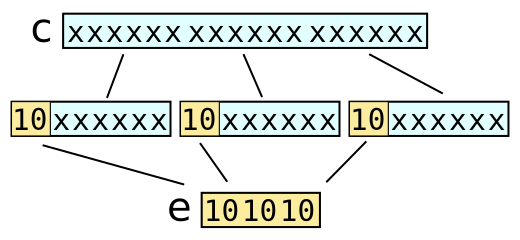
Internally (CPython, PEP 393):
- Compact Unicode storage
- 1 / 2 / 4 bytes per character
- Chosen automatically
🧠 You do not control encoding in strings
Encoding happens only when converting to/from bytes.
2️⃣ ENCODING vs DECODING (BOUNDARY RULE)
Encoding: str → bytes
b = "hello".encode("utf-8")
Decoding: bytes → str
s = b.decode("utf-8")
🚨 Golden Rule (Interview Gold)
Decode once at input boundary, encode once at output boundary.
Violating this causes:
- Mojibake
- Crashes
- Data corruption
3️⃣ lower() vs casefold() (VERY IMPORTANT)
"ß".lower()     # 'ß'
"ß".casefold()  # 'ss'
When to use what?
| Method | Use Case |
|---|---|
lower() | Display |
casefold() | Case-insensitive comparison |
Interview-grade answer:
“For Unicode-safe, case-insensitive matching, always use
casefold().”
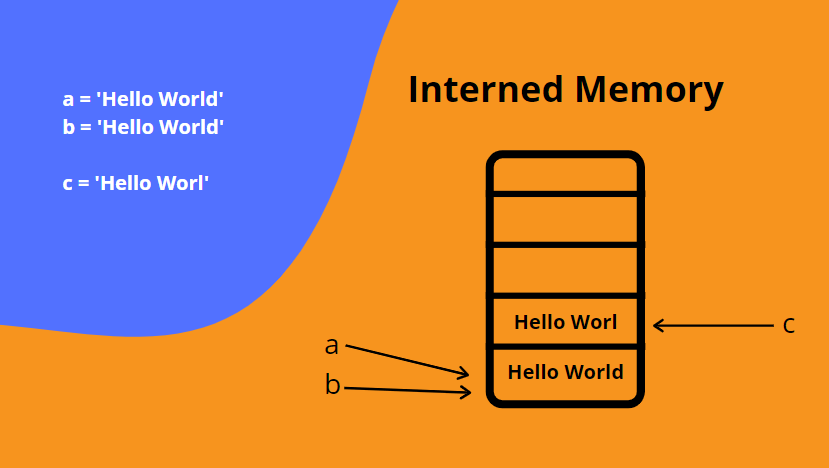
4️⃣ STRING INTERNING — WHAT IS ACTUALLY GUARANTEED
a = "hello"
b = "hello"
a is b   # Often True
Why?
- CPython interns small literals
- Optimization only
But:
a = "".join(["he","llo"])
b = "hello"
a is b   # ❌ Not guaranteed
🚨 Interview Rule
Never use
isfor string equality.
Use==.
5️⃣ HASHING & DICT KEYS (WHY STRINGS ARE FAST)
- Strings are immutable
- Hash is computed once
- Hash is cached
This is why:
dict["username"] # fast
Mutable objects cannot be dict keys.
6️⃣ PERFORMANCE TRAPS (VERY COMMON)
❌ Trap 1: String concatenation in loops
s = ""
for x in data:
    s += x
Why bad:
- New string every iteration
- O(n²) time
- Excess memory churn
✅ Correct:
"".join(data)
❌ Trap 2: Excessive slicing
s[i:j] # creates new string
In loops → expensive.
❌ Trap 3: Repeated .lower() in loop
for word in words:
    if word.lower() == target:
Better:
target = target.casefold()
for word in words:
    if word.casefold() == target:
7️⃣ translate() — FAST BUT RARELY KNOWN (INTERVIEW BONUS)
import string

table = str.maketrans("", "", string.punctuation)
clean = text.translate(table)
Why good:
- Runs in C
- Faster than replace loops
- Ideal for sanitization
8️⃣ REGEX vs STRING METHODS (INTERVIEW JUDGMENT)
Use string methods when:
- Simple patterns
- Fixed delimiters
- Known structure
Use regex when:
- Complex patterns
- Variable structure
Interview line:
“Regex is powerful, but string methods are faster and safer when applicable.”
🔥 RAPID-FIRE STRING INTERVIEW QUESTIONS (20)
Answer these instantly:
- Why strings are immutable?
- Why strings are hashable?
find()vsindex()?split()vspartition()?- Why
+=is slow? lower()vscasefold()?- Why
join()is string method? - Why
"a"*1000is fast? count()overlap behavior?- Unicode digit surprise?
- Why slicing is O(k)?
- Why string comparisons are fast?
startswith()vs slicing?- When to avoid regex?
- Why
isis unsafe? - Encoding boundary rule?
- When
.strip()fails? - Best palindrome approach?
- Sliding window use-case?
- Why
translate()is fast?
If you can explain these → you pass senior interviews.
🧠 STRING MASTERY — FINAL MENTAL MODEL
Think in this order:
- Immutable?
- Unicode-safe?
- One-pass or multi-pass?
- Builder pattern needed?
- Hashing involved?
- O(n²) hiding anywhere?
📝 FINAL STRING ASSIGNMENT (MANDATORY)
1️⃣ Predict output (NO RUNNING)
print("ß".lower() == "ss")
print("ß".casefold() == "ss")
2️⃣ Coding (Clean & Efficient)
def normalize_and_compare(a, b):
    """
    Compare two strings case-insensitively,
    Unicode-safe, ignore spaces.
    """
3️⃣ Explain (Interview style)
Why is this bad?
if s.lower() == "admin":
🎯 YOU HAVE COMPLETED STRING MASTERY
You now have:
✔ Method-level knowledge
✔ Performance intuition
✔ Unicode correctness
✔ Interview-ready patterns
🔜 NEXT MODULE OPTIONS (Choose One)
👉 “START LIST MASTERY (Module 2)”
(dynamic arrays, methods, traps, 30+ problems)
👉 “START DICTIONARY MASTERY (Module 3)”
(hash tables, collisions, interview gold)
👉 “START PYTHON CODING INTERVIEW BLITZ”
(mixed problems, timed, FAANG-style)
Say the one you want — we continue immediately.